
The spark counter
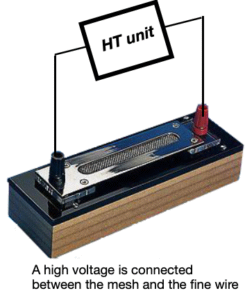
A simple instrument which is still used in physics education as an introduction to explaining how a Geiger counter works.
Mounted on an insulating block is a wire mesh under which is stretched a fine wire. A high voltage source is connected between the two, but set so that it is not quite high enough to cause a spark to jump between the two.
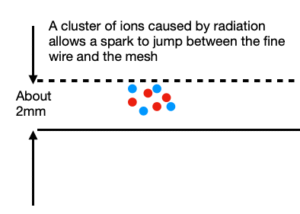
All radioactivity will cause ionisation in the air. Alpha particles in particular, cause the creation of many ions, close together. If some of the air between the wire and the mesh is ionised that will just be sufficient to allow a spark to jump at that point. By counting the sparks an estimation of the strength of radiation can be made.
The Geiger Muller tube
The essential working part of a Geiger counter is a Geiger-Muller tube often abbreviated to GM tube.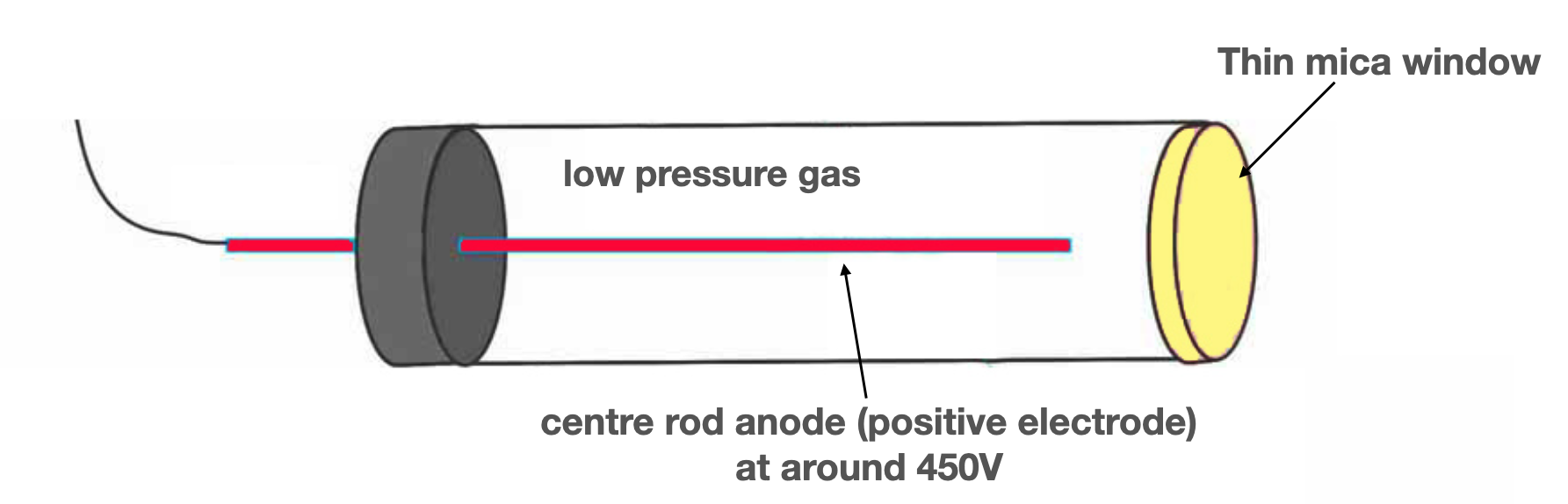
It works in a similar way to the spark counter. Radiation entering the tube via the thin mica window will cause collide with molecules of the gas inside “chipping off” electrons. These electrons (negatively charged) will be rapidly accelerated towards the centre rod which is at a high positive potential, whilst the outer casing is earthed. As these electrons accelerate they are likely to strike more molecules causing an avalanche of charge. This pulse of charge is detected by a counter and the radioactive particle is then recorded.
The more massive positively charged ions will move more slowly to the outer casing where they will be neutralised.
The process is dynamic and is best shown in the video below.